
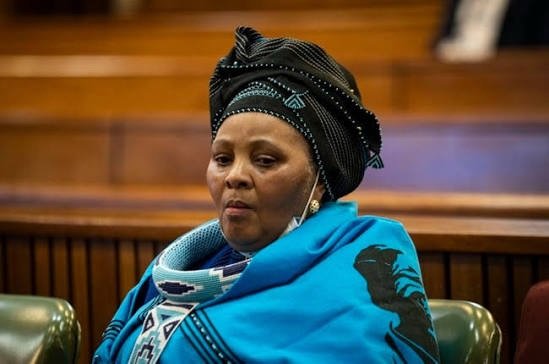
The halls of justice in Pretoria delivered a stark reality check on Monday for former National Assembly Speaker and Defence Minister Nosiviwe Mapisa-Nqakula, as her bid to evade prosecution crumbled under the weight of state evidence.
Judge Mashudu Munzhelele, presiding over the Gauteng High Court in Pretoria, firmly dismissed Mapisa-Nqakula’s application for a discharge under Section 174 of the Criminal Procedure Act, decreeing that the prosecution has successfully established a prima facie case that the seasoned politician must now legally answer to.
The high-stakes legal battle places Mapisa-Nqakula directly at the centre of a multi-million-rand corruption storm. She stands accused of leveraging her former executive authority as the Minister of Defence and Military Veterans to solicit and accept massive kickbacks. The state has lined up 12 counts of corruption alongside a single count of money laundering, painting a picture of systemic greed that allegedly compromised the upper echelons of the country’s military leadership.
The core of the prosecution’s narrative rests on a series of transactions occurring between 2016 and 2019. During this window, Mapisa-Nqakula allegedly pocketed R4.5 million in bribes including R2.1 million delivered as cold, hard cash from Nombasa Ntsondwa-Ndhlovu, a prominent logistics service provider for the South African National Defence Force. To mask the illicit nature of these exchanges, the pair allegedly adopted traditional African medicine terminology, relying on code words such as indumba, impepho, amayeza, and snuff to reference the incoming cash flows.
The defense launched an aggressive bid to halt the trial in its tracks, arguing that the state’s case was structurally hollow and critically dependent on the testimony of Ntsondwa-Ndhlovu, whom they painted as a deeply unreliable witness seeking immunity through a state plea bargain. Mapisa-Nqakula’s legal team insisted that the contradictions in the state witness’s narrative warranted an immediate acquittal before the defense even needed to call a single witness to the stand.
However, Judge Munzhelele dismantled this line of reasoning by reminding the court of the strict thresholds governing a Section 174 application. The judge clarified that the state does not need to prove guilt beyond a reasonable doubt at this mid-trial junction, nor does the court need to resolve every microscopic credibility dispute between witnesses. Instead, the prosecution merely needed to present enough foundational evidence such as the digital footprints left in WhatsApp communications and corroborating financial trail charts, that a reasonable court could convict on.
By ruling that a prima facie case exists, the court has effectively shut down Mapisa-Nqakula’s escape hatch, forcing the former minister to step into the witness box or call upon her own evidence to clear her name. Having pleaded not guilty to all charges, she must now prepare for a rigorous defense phase as the trial plunges deeper into the murky waters of state corruption.