
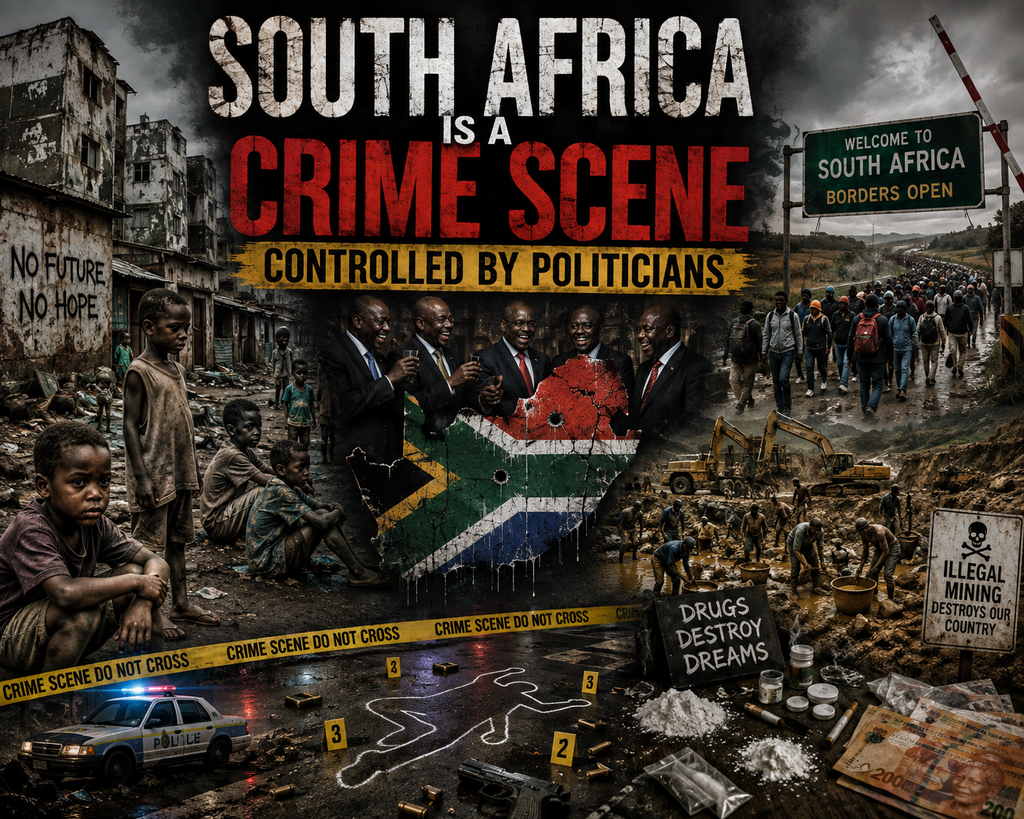
The Architecture of Inaction: Why South Africa’s Border Crisis is a Corporate Enterprise:
For years, the South African public has been fed a steady diet of bureaucratic excuses. We are told that our borders are too vast to police, that the Department of Home Affairs is bottlenecked by systemic backlogs, and that the state simply lacks the physical and financial capacity to manage the influx of undocumented migration.
This is a carefully engineered lie. Incompetence is an easy shield because it implies a state that wants to do better but just lacks the tools.
The reality is far more sinister. The chaos at our borders and the lawlessness in our municipal centers are not accidental failures of governance. They are the deliberate, highly managed structural conditions required to sustain a multi billion rand shadow economy.
Our borders are not porous because we cannot close them, they are kept open because order does not pay dividends to the political and economic elites who control the state.
The Narco-Rand Alliance: Drug Kingpins and State Protection:
The illicit drug trade paralyzing South African communities is not an underground operation hidden from view, it is a highly visible corporate enterprise that requires high level political shielding to survive. Transnational syndicates, heavily involving foreign drug kingpins operating in major metros from Johannesburg to Cape Town, have successfully institutionalized bribery at the highest echelons of the state.
Running a modern political campaign or maintaining a factional power bloc within dominant parties requires massive, untraceable liquidity. Drug syndicates provide the perfect black budget to fund political operations, buy internal party votes, and bankroll lavish lifestyles.
In exchange for these cash injections, politicians use their executive leverage to influence the deployment of police generals, ensure intelligence units look the other way, and sabotage active investigations.
This exact dynamic has been laid bare at the Madlanga Commission of Inquiry, where evidence has exposed how deep rooted criminal networks utilized high-ranking political fixers to disarm elite police units.
The open border ensures that the drug supply chain remains unbroken, turning a public health catastrophe into a political goldmine.
The Micro-Retail Monopoly: Unregulated Spaza Shops and Local Government Extortion:
The systematic takeover of the township economy by foreign-owned spaza shops is another glaring example of lawlessness being maintained for financial gain. While local South African traders are choked out by stringent compliance laws, thousands of undocumented operators set up shop without valid permits, trading standards, or tax compliance.
This is not an administrative oversight, it is an organized extortion racket that feeds local politicians and ward councillors. For an undocumented trader, survival depends on paying a continuous, informal tax to local government officials, municipal inspectors, and corrupt law enforcement officers.
Many of these networks are tightly organized into cartels that buy goods in bulk from politically connected wholesalers, ensuring everyone gets a cut.
The cash generated in the informal spaza economy largely unbanked and untaxed is easily laundered into local political structures to fund municipal election campaigns.
Even the proliferation of expired and counterfeit food products is tolerated because the syndicates manufacturing and distributing these goods are deeply embedded in the supply chains of politically connected tenderpreneurs.
The politician protects the illicit supply chain, the inspector takes a bribe to ignore the health hazard, and the local community pays with its lives.
The Shadow Mining Cartels: Zama Zamas and the Looting of the Economic Core:
Nowhere is the protection of profit more visible, and more silent, than in the destruction of South Africa’s mining sector the absolute core of the national economy.
The thousands of heavily armed, undocumented miners known as Zama Zamas operating in the shafts of Gauteng, North West, and the Free State are the foot soldiers of a highly sophisticated, militarized corporate syndicate.
Yet, the Presidency and the Ministry of Mineral Resources consistently refuse to declare this armed capture a national crisis.
This media blackout and executive quietness exist because the gold, diamonds, and chrome extracted by Zama Zamas are funneled upward through a complex supply chain involving local scrap yards, international refineries, and politically connected mining magnates.
High ranking politicians and their corporate fronts frequently own the logistical companies and export licenses used to blend this illicitly mined mineral wealth into the formal market.
An orderly mining sector means strict audits and transparency mechanisms that dry up private cash flows. Chaos, therefore, is actively maintained because it is infinitely more profitable than the rule of law.
The silence from Pretoria is the sound of absolute complicity, the core of South Africa’s economy is not being neglected, it has been handed over to a political-criminal alliance that treats the nation’s mineral heritage as a private ATM.
The Inversion of Justice: Protecting the Criminal, Arresting the Citizen:
The ultimate betrayal, however, lies in how the state handles resistance. Politicians are not blaming foreign nationals, they are actively protecting them.
When desperate, abandoned communities stand up to chase away the drug lords, close down illegal operations, or protest against un-inspected spaza shops selling toxic goods, the reaction of the state is swift, brutal, and immediate.
The government does not deploy tactical response units to dismantle the syndicates, they send public order policing to fire rubber bullets, unleash tear gas, and arrest South African citizens who try to defend their own neighborhoods.
Politicians weaponize human rights terminology and legal frameworks to criminalize community-led defense, labeling ordinary citizens as “xenophobes” or “vigilantes” to justify their suppression.
By using the police to arrest South Africans who protest against lawlessness, politicians are sending a clear, terrifying message, ‘Do not touch our revenue streams.’
The state apparatus has been transformed into a private security firm for illicit cartels. By shielding undocumented operators and disarming the local populace through state sanctioned violence, the political class ensures that the angry voter is suppressed, the border remains open, and South Africa’s sovereignty continues to function as a highly profitable corporate enterprise.